“Please don’t book or organise anything, while we’re in Singapore. Let’s wing it, shall we?” said Terry and the kids, when I mentioned making a table reservation at Restaurant Andre, voted #3 of Asia’s 50 best restaurants.
Weeks before we left for Singapore, I quizzed friends and researched the dining scene, trying to figure out some sort of food trail. My 12-day plan was to mix visits to hawkers centres with more upmarkets venues ( like Andre! ). I think I scared my lot with the idea of spending a fortune in a high-end establishment when there is so much good food to be enjoyed in cafes and hawkers centres, so I did as I was told and totally winged it!
To be honest, there is an incredible amount of delicious food to eat in the island city, and the diversity of ethnicities present means a formidable choice of cuisines: Chinese, Malay and Indian food make up the bulk of the offering but many restaurants also offer Western and other foods from around the world. Our holidays turned into a massively tasty food trail thru Singapore, from the casual to the fancy, the wonderful to simply meh ( is that a word? ), and the cheap to ridiculously pricey!
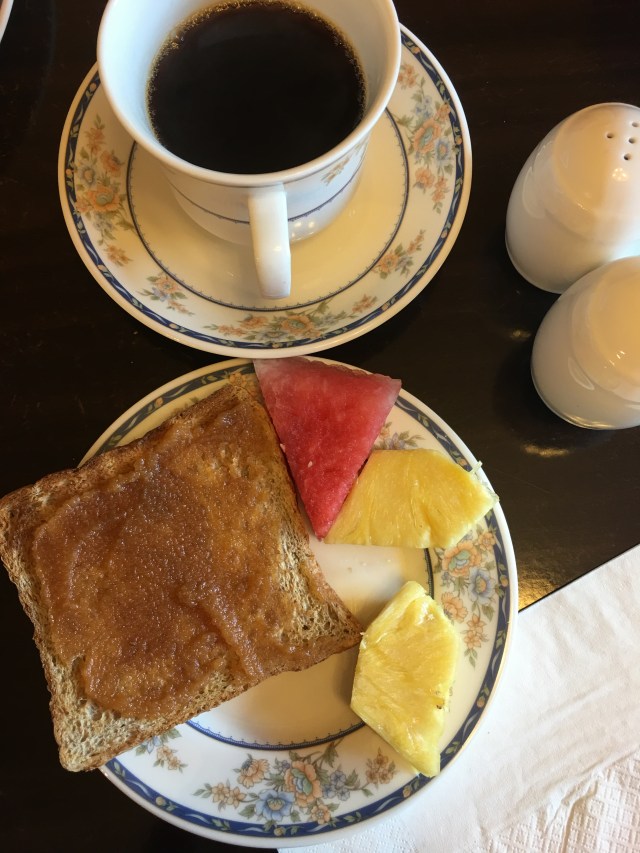
Every morning, we started with breakfast in our apartment complex the Village Residence. Even though the apartment came with a full kitchen, breakfast was included during the week, served in a separate apartment purposely set up. Displayed buffet style, the selection would include sweet pastries, fruits, cereals, yoghurt, and a salad as well as hot choices like egg dishes, cocktail sausages, baked beans and mini quiches. The hot menu, cooked by the lovely staff ladies, changed everyday to provide variety to the residents who I suspect were on long term stay ( this residence is widely used by relocating expats, we’re told ). So it became a game with the kids, guessing what treat would await in the breakfast room: waffles, pancakes, sausage rolls, even samosas…? I became quite partial to Kaya Toast ( a jam made from coconut, eggs, sugar and pandan leaves served on buttered toasted bread, a local specialty ) and strong coffee. Sometimes, when still full from the day before, I’d have a small bowl of salad to keep light.



Lunch would invariably be at a hawker centre or a food court. The difference is mostly in the setting, while the food is just as tasty no matter where: hawker centres are traditional eating places for Singaporeans, they are generally open-sided structures, as in under a roof, but no walls, definitely not air-conditionned, with a row of food stalls offering different local cuisines. Food courts are basically air-conditonned hawker centres found in shopping malls, with more spacious food stalls. As these get very busy at peak hour, we learnt quickly about the local etiquette of bagging a table first, leaving one of the kids to mind the seats while the rest of us would wander around to order. Another smart move would be to wait for the crowds to die down, but then a lot of stalls have ran out of food!
Beside enjoying some of the tastiest food, the best part about hawker food is the wallet friendly prices. Some dishes start as low as S$3.50 ( for the noodles ) up to S$12 ( for a plate of satays ) and drinks can be had for S$1. I am telling you, this is foodie heaven!
Some of the hawker centres we enjoyed:
- Chinatown Complex Food Centre – Located on the second floor, this is probably the biggest hawker centre in Singapore with over 250 stalls. Our guide Leong from Betelbox Tours took us there, and explained the rating system for every stall, as granted by the health authorities: A for best, thru to D for worst. This is relatively recent, part of an endeavour by the government to “clean up” the hawkers industry by moving food sellers from the streets to an integrated centre where they not only can share common utilities but also make it easier for customers to “shop around”. We were offered our first samples of Peranakan cuisine: popiah ( a thin pancake filled with vegetables, like a fresh spring roll)
 chicken rice ( poached chicken served with shallots and ginger dressing, along with rice, soup and chili sauce )

and chwee kueh ( steamed rice cakes topped with chopped preserved radish and chili sauce)

Leong fetched us some freshly squeezed sugar cane juice, a very refreshing drink in the humid heat which will become the beverage of choice while out and about. There is a wet market located on the basement where you can buy fresh produce ( I didn’t, I just couldn’t see the point in me cooking in the apartment! ) and inexpensive souvenirs on the ground floor which makes for an all in one destination if you’re pressed for time!


- Bedok Interchange Hawker Centre – We met our friends Bob and Doreen there. It is about 45mn by MRT from downtown, located right above the MRT station and next to the bus interchange so we didn’t have to walk too far. After the usual hunt for a table ( made harder than usual as there were 6 of us!) I happily let Doreen, who lives locally, pick most of the dishes: nasi padang ( steamed rice with a variety of meat and vegetables on the side ) for Marc
 savoury mince and egg for Anne who was overwhelmed with the choices!

For us it was oyster omelette and singapore noodles. I selected char lor mee ( yellow noodles with pork and gravy ) and mutton ribs soup ( not such a popular choice! ), and we added a dozen satays to nibble on to soak up the beers!

- Tiong Bahru Market – a short bus ride from the apartment, I took Marc with me on a mission to sample as much as we could manage! We arrived around 11am, and enjoyed the place nearly to ourselves. Started with a fresh avocado milkshake ( the secret is in the condensed milk! ), felt brave and tried a grass jelly drink. Quite popular in Singapore, it is supposed to have cooling properties, made from a herbal plant called mesona chinensis. It tasted super sweet, a bit like bubblegum, and honestly felt like I was slurping jelly worms. It was not bad, just weird and neither Marc or I could finish it.


We stuck to savoury dishes after that: wonton noodles for him


bak chor mee for me ( minced pork noodles, my absolute favourite dish of the whole holidays!)


and by the time we finished our meals, the lunch time crowd had gathered, queues forming around the most popular stalls. As busy as it was, I liked the fact that there were not that many tourists, and the locals were so friendly, when I asked them where they got their yummy looking plate of noodles from they enthusiastically pointed to the stall !

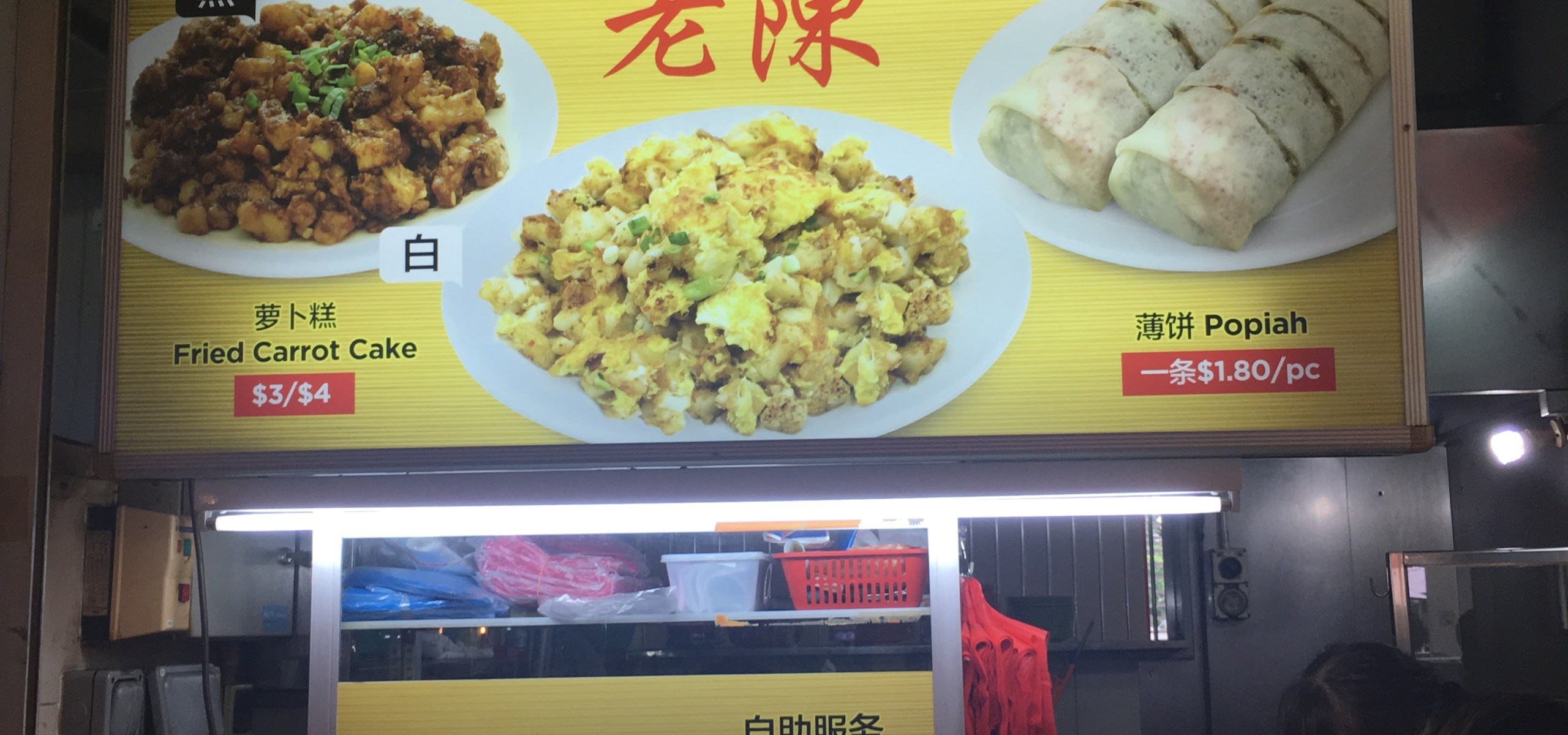
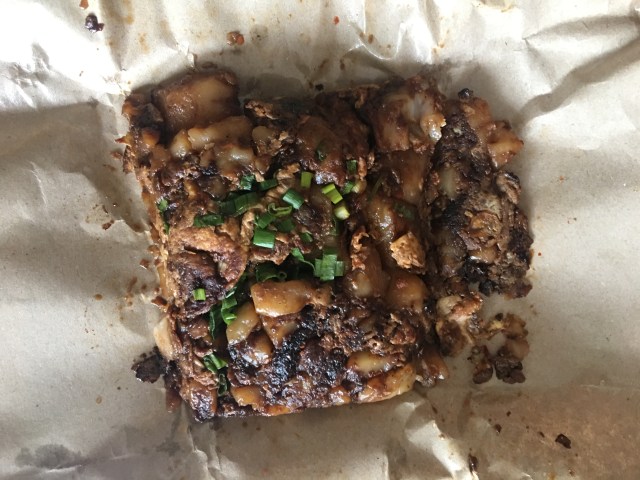
We picked up some chwee kueh, carrot cake ( nothing to do with carrots, it is a fried white radish and rice flour cake, mixed with eggs, garlic and spices), and nonya kuehs ( steamed rice flour and coconut cakes ) to go so that Terry and Anne could have their own hawker picnic at the apartment.



Some of the food courts we enjoyed:
- Rasapura Markets – we discovered this slick food court on our first day, while visiting Marina Bay Sands Mall. Flanked by an ice skating rink, the stalls cover most bases, from beef noodle soup to Hong Kong roasted meats and Mee Rebus. They also include western choices like pizzas and sizzling steaks, which came in handy for Anne when tired of Asian food. This is not the biggest, but probably the busiest food court we’ve been to: on the 3 occasions we came down ( for lunch and dinner ) twice we circled around for approx 15 minutes before finding a table, once we gave up and ate standing up at one of the high benches surrounding the rink. Prices are higher than local hawker centres ( S$15 for a roasted meat meal) ) but it is still a bargain compared to other eating options in the mall.


- Food Republic – with 13 atriums spread out on the island, this is no ordinary food court. The kids and I ate at the Somerset venue, located in the middle of the 313@Somerset mall. It takes up the entire length of the building, can seat 1000 people, features 22 food stalls and 4 mini-restaurants! Each stalls has a clearly identified character of its own: Padang Kitchen, Beef noodles, Indian delights, Fried Chicken…Each of us made a point of grabbing a meal for under S$10, and came back with plenty of change! While you can buy drinks from a dedicated stall, there are also attendants “aunties” pushing carts around tables, offering fresh lime juice or bottled water for S$1.


- Takashimaya Food Village – Ok, this one is in the basement of the super exclusive Takashimaya Department Store on Orchard Road. It offers your usual hawker food with an emphasis on Japanese cuisine. The setting is a bit different, as you are also surrounded by upmarket stalls selling French chocolates, Tea sets, beautifully wrapped imported fruits…


We happened to be there during the Takashimaya’s Food Lovers Fiesta, which gathered over 50 stalls in the store’s square. None of us bothered with a traditional meal, instead we queued to taste the irresistible morsels on offer: anchovy sushi roll (ok) pork sausages ( yum !)
deep fried squids ( too much!! ), cold matcha tea ( intriguing)


, durian sago pomelo ( I was curious, never again!)…


it was all interesting, but nothing that I would rush to order again.


Well, that just about wraps up the street food, which we enjoyed mostly at lunch. Did you notice I hardly mentioned drinks? The only daytime beverage I had was water or juice. The reason was primarily because of the heat, and alcoholic drinks are not the best to quench a thirst ( though Terry will disagree! ). Another reason was that we were on the go all the time, and a glass of wine would have slowed me down to the point of writing off the rest of the day. Beside, alcoholic drinks are expensive in Singapore, particularly wine and spirits which are not for sale in hawker centres. Surprisingly beer is available there at a reasonable price, which was lucky for Terry who is very partial to a cold lager when eating spicy food !!


12 days in Singapore with 2 teenagers. What to do?
Some have argued that it is a very long time to spend in a city with not many touristic activities. After all, Singapore does not have many beaches, high peak mountains, or monuments. Most people come here either for work or as a stopover on the way to or from somewhere else.
We didn’t feel like hurrying from one place to the next though, and very much as we did while cruising, preferred to settle in and experience the city like locals.
This post is a recount of what we did in Singapore ( besides revisiting our old haunts ) rather than a guide of What To Do. As the four of us have different interests, it was very much a matter of pleasing the most while accomodating the few!
We took a guided tour of the city. Although Singapore is a very easy city to self-navigate we wanted someone to give us the heads up about all the changes that occurred in the past 30 years and help us get our bearings. It also was Marc and Anne’s first visit and I felt it best to have a local showing them around. We organised a tour themed ” Singapore Miracle Tour ” with Betel Box Tours, which took us thru the 4 main historical and cultural precincts of the city: Chinatown, Kampung Glam, Singapore River and Marina Bay. Our guide Leong Woon, was well versed on the issue of land reclamation and urban planning, and gave us fascinating insight into the rationale behind the continuous expansion of the island. My favourite part of the tour was the visit of the Urban Redevelopment Authority (URA) display, a reduced scale of the island showing existing dwellings as well as planned developments. Always love people with a vision! The tour also includes visits to a wet market and food centres, with tips and recommendations on which is the best stall ( though, in Singapore, everyone has their own favourite, so if you ask 10 people you may end up with 10 different answers!) For a history and food enthusiast like me that ticked a lot of boxes!! Ours was a 4- hour private tour, which involved pick up and drop off from our accomodation. The walking was minimal, much to Anne’s satisfaction as she was struggling with the heat in the first few days.


We walked till our feet hurt. The app on my phone shows that I averaged 16500 steps every day, that is about 12 kilometers. Whether we were exploring, shopping, or simply commuting, I am glad we packed comfortable shoes.
Starting with a stroll along the Riverwalk, from Robertson Quay to Marina Bay and back. It is not a particular hard walk, but it is a long and hot one, especially on a sunny day. As you make your way down river, along Clarke Quay and Boat Quay, there are plenty of restaurants and bars to check out, amongst colonial buildings.


The reward at the end is Marina Bay, a stunning development on reclaimed land which houses not only a 5 star hotel complex but also a super luxurious mall, food centre, entertainment precinct, city park and museum. We first discovered it after a hot and sweaty 90 minute walk, and the kids and I were totally gobsmacked wondering who could come up with the idea of sitting a giant ship on top of 3 high-rise buildings, and digging a fully air-conditionned shooping centre underneath. No so Terry whose aversion to shops and crowds is well known, and was much happier walking around the waterfront.


As Anne gave up on walking after day 2 and decided to stay in for a while ( too hot, sore feet, etc…),Terry offered to keep her company and spent most mornings studying in our apartment ( I find that WIFI and aircon have such a strong hold sometimes! ). Lucky Marc likes exploring as much as I do so he turned into my walking buddy/model/food taster/assistant, tagging along wherever I was heading.
We came back to Marina Bay twice, to take another look at the shops ( sans Terry! ) but also for cool photo shoots. In fact, I declared every walk a Street Photography workshop and we had fun strolling thru Fort Canning park,


wandering around the CBD looking up skyscrapers,
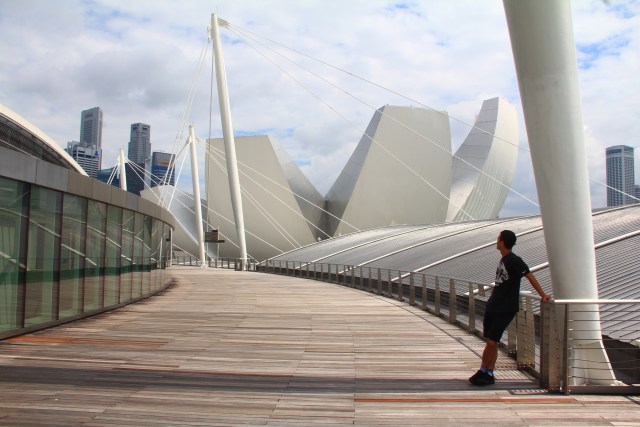

sticking our noses inside Raffles Hotel for a bit of nostalgia,


hopping on the MRT for excursions in random neighborhoods to experience some of the local life. Tiong Bahru and Little India were my favourites: one for its cool vibes with bookshops, cafes and old school market and food centre in the middle of art-deco housings,


the other for the colours, scents, sari shops and temple hopping fun.


The kids loved Haji Lane in the Kampong Glam area , which Marc nicknamed “ the Newton of Singapore ” because of its hipster bars and local fashion boutiques.


Outside of the city, Punggol Point offered a nice respite with its wide boardwalk and restaurants and Sentosa was a world of its own, which deserves at least 1 full day of exploration if you’re into amusement parks and beach bars.


We split teams to visit museums, as we all have different interests. Terry liked the URA with its display of “before and after” pictures of Singapore, while Marc could not get enough of the urban landscape and the hundreds of ships crowding the harbour. Anne’s preference was for the ArtScienceMuseum in Marina Bay and I was left on my own to visit the remarkable Asian Civilisations Museum where I lost myself in centuries of ancient ceramics and china, carvings and textiles.


We shopped a lot. From iconic malls to independent bookshops and curated local boutiques, there is something for everyone. Our visit coincided with the Great Singapore Sale, so Anne and I were really excited at the prospect of a shopping spree. Sadly Singapore isn’t the wallet friendly paradise it used to be ( partly due to our dollar but also the high cost of living ) so we merely looked at the high street chains and luxury brands on Orchard Road and the Shoppes at Marina Bay Sands, amazed at the numbers of customers actually buying! Marc was not shy and walked into stores like Valentino or Gucci and chatted with some of the sales staff, who were super friendly and approachable ( we could have been billionaires for all they knew! ). Places like Zara and Uniqlo were where Anne gravitated, much to Terry’s dismay “ you can buy the same stuff in Australia! “. Well, he was partly right, it turns out they have different styles for a different clientele.


Marc and I went shopping for camera and audio equipment at the Funan Digital Mall and the Adelphi building, only to find that the prices were not as advantageous as we thought. Also neither of us really knew what we were doing so were not prepared to spend hours bargaining ( we’re amateurs, really! ).


More luck and more fun was had at independent gifts and bookstores in the Bras Basah Complex, as well as the beauty stores for cosmetics unavailable in Australia ( says Anne ).
I had a field day at the Mustafa Centre, Little India’s massive shopping complex open 24/7: dragging Marc along while on the lookout for cheap cookware, we wandered thru 6 levels peddling everything from electronics to shoes, luggage, dress material, even groceries! The indian copperware selection was disappointingly small, however there was an unusually large choice of melamine sets, ideal for props or casual dining so I filled a bag with a few items. But the most fun was in the gold jewellery section we stumbled on: Indian people like their gold, and we were surrounded by the stuff. Lavish sets, some plain others incrusted with precious stones…I asked for the price of a set of pretty earrings. They are sold by the weight and the price changes daily. Today’s rate was $$54 per gram, so the 46g pair would cost $$2500. Oh, they can only be sold as a set with the gorgeous necklace sitting next to it. Marc dared me to buy the lot and surprise Terry with it “ Go on Mum…” Love that boy. To his question “ Who on earth spends so much money on jewellery?” I replied “ Maybe your next girlfriend! ”
We went to the Zoo. This was Anne’s choice, once she recovered from her earlier walks with us. I’ve seen my fair share of zoos during our travels, so I tend to be a bit blase but I must admit that Singapore Zoo is impressive with its mix of interactive attractions and semi-freely roaming animals. Some of them were a bit lethargic, understandably so as we visited in the middle of the day but others bounced around full of energy. This was the case of the monkeys, probably my favourites along with the white tigers! There is a section for young kids, Rainforest Kidzworld, which Anne and I didn’t go in ( she is 14 and over it, she tells me) so it took us only half a day to tour the rest of the zoo. I must point out that getting there took nearly the same amount of time, as the MRT line from downtown stops in Ang Mo Kio, a major hub where you can take a bus for the zoo. What the guide books don’t tell you is that while the MRT section takes 20 minutes, the bus ride takes another 45 minutes. As the bus was packed it was standing room only and by the time we arrived at the zoo, my feet would not cooperate any longer in the heat. Lucky there is the option to hop on a small train for an extra S$5 which allowed us to move around the enclosures and attractions quite easily.Needless to say that I was happy hop on a cab for the return journey to the city ( S$19 for a 25 minute ride and saving my feet, bargain!)


We climbed buildings searching for the best panoramic view. Well, maybe not climbing, but took every opportunity to hop on a lift to a top floor for a view of the city. Hotels are good for this, from the Hilton to the Fullerton, but the best vantage point has to be at CE LA VIE bar atop the Marina Bay Sands Hotel with its jaw-dropping panorama of Singapore. For S$20 you can take the lift to the 56th floor’s Skypark Observtion deck and enjoy the most stupendous view of the city and the Singapore Strait. For S$23, you can take the lift to the 57th floor where the bar and restaurant await with the same view, and the added advantage that your entry fee is redeemable for food or drinks. What a wonderful idea, we thought we’d time our visit with sunset to watch the city by night. Except that a beer costs S$25, tables are nearly impossible to score, and another 500 people had the same idea as us making it difficult to even find a spot for taking photographs. I gave my drink voucher to Terry and let him queue at the bar, spending time snapping pictures instead. Yes, the crowds were frustrating and it was not the relaxing sunset drinks session we anticipated, but it certainly was worth the one-off visit.


We would not miss Gardens by the Bay, a massive green patch sprawling across over 100 hectares of reclaimed land. Not your usual park though, it features 18 high-tech Supertrees, steel clad concrete structures covered with over 162,000 plants, quirky sculptures, lakes, heritage gardens, and most wonderful conservatories shaped like giant nautilus shells. Access to the gardens is free, while entry to the conservatories cost S$28 per person. I could have spent an entire afternoon there, smelling the flowers and taking photos however we only allowed a couple of hours to coincide with sunset and the Garden Rhapsody, the light and sound spectacular that occurs every night. What an awesome sight, by day or night!


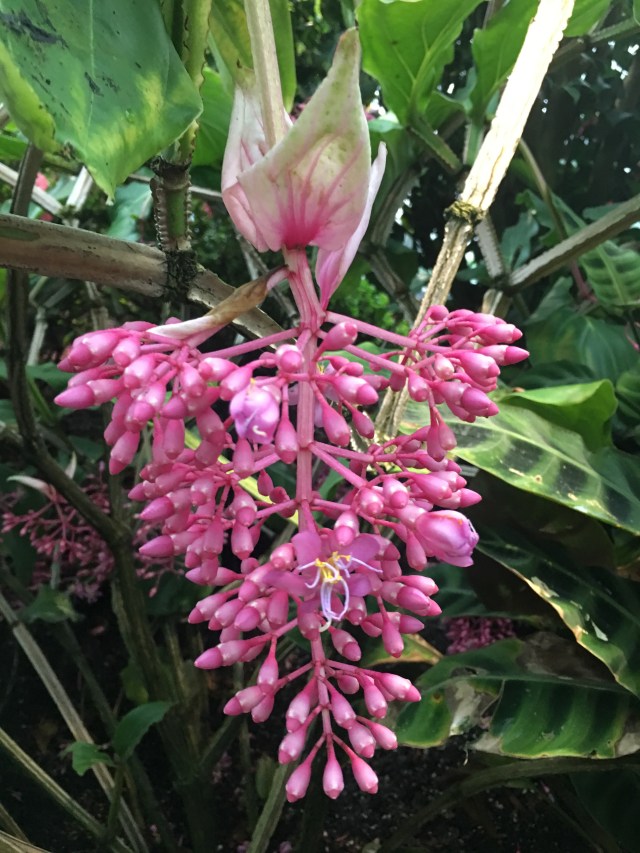


We ate. Until our sides split! I thought I was obsessed with food, but I have nothing on Singaporeans, for whom eating seems to be a national sport. Our routine was simple: breakfast at the apartment, cooked by the lovely ladies of Village residence. The we’d hit the hawkers centres for lunch, where I’d make a point of trying a new dish every day. Dinner would depend on our mood: neighbouring establishments when feeling lazy, local takeaway on tired days or high-end restaurants for celebrations. I would need an entire post to talk about the food alone so stay tuned. But let’s just say that while a lot of things are expensive in Singapore, eating is not one of them. Sure you can fork out S$400 for a fancy meal if you want to, and imported western food is pricey but with knockout street food at wallet friendly prices, we enjoyed the local fare so much I told Terry I would not mind stopping over for a few day just to eat!!


Phew, that is a massively long post, my apologies for it. But I just had so much to say about Singapore! Can you tell how much we loved it here? And we have not touched on the food scene yet…so stay tuned for more posts.

Recently I surprised myself ( and everyone that knows me ) by subscribing to a fresh food delivery service. I know what you are going to say. “ Voahangy, you love menu planning, shopping for food, prep and set up, etc…How can you ask someone else to do it for you, let alone PAY them??”
Well, I will say that they are clever marketing people, who appeal to my love of cooking but also happened to call in when life was super hectic at home. With new projects on the go and travelling, I liked the idea of having some meals already worked out for me: ingredients are already weighted, apportioned and conveniently packaged in a bag ( one bag per meal) with step-by-step recipes included. Just keep the bag in the fridge until ready to use.
This is no TV dinners though, all food is fresh ( meat, cheese, vegetables, fruits, spices and nuts ) and all meals still require some amount of prep like peeling, chopping, stirring, etc…but the recipes are easy enough to have dinner ready within 45 minutes and even have my teenage daughter interested in taking over the stove occasionally!
We are still testing the service and the recipes and I plan to write a more complete review later, but as we are wrapping up the week I wanted to at least give you an idea of a meal we had.
It was a Japanese flavoured Broccoli and Pea Miso Soup, which was perfect for a cool winter’s night. All fresh ingredients for the soup were provided, except for the staples like oil, water and soy sauce. The only thing was that I was not sure it would be filling enough for the teenagers in the house. I had some steak that I purchased earlier, so wanted to serve that as well but without having to cook another side dish ( that would defeat the entire purpose of making a quick and simple meal!!)
So, I ended up “deconstructing” the recipe: using the ingredients provided, I cooked the vegetables in the stock but instead of serving a vegetable soup, I strained them and turned them into a mash served the stock separately as a soup, along with the cooked steak.
While the flavour and taste of the original recipe remained, the dish had a completely different texture and became Fillet steak with Broccoli and Pea Mash and Miso Soup.
As for the quantities, adding the meat meant having vegetable mash left over, so enjoyed the vegetarian lunch the next day. Happy days!

Broccoli and Pea Mash with Miso soup
Adapted from a recipe by Marley Spoon
As I mentionned most ingredients were already supplied, but they are easy to source from the supermarket or any Asian grocery store.
Serves 4 as a main, plus leftovers vegetables for 2or 3 for lunch
Ingredients:
1 tbsp vegetable oil
2 leeks
3 garlic cloves
1 knob of ginger
4 heads of broccoli
8g dashi powder ( about 1 tbsp )
4 cups water
800g frozen green peas
60g pepitas ( about 1/3 cup )
5 g sesame seed mix ( about 1 tbsp )
2 tsp soy sauce
5 g shichimi togarashi ( about 1 tsp )
75g white miso paste ( approx 1/2 cup )
Roasted seaweed
- Trim, clean and slice the leeks thinly. Peel and crush the garlic, grate the ginger. Cut the broccoli into small florets and roughly chop the stems.
- Heat the oil in a large pot over medium heat. Add the leeks, garlic and ginger, and cook stirring for about 3 minutes until softened a little.
Add the broccoli, dashi powder and the water. Bring to the boil then reduce to a simmer and cook, covered, for 8 minutes or until broccoli is soft. Add the peas and cook for another 2-3 minutes until heated thru. - In the meantime, put the pepitas and almonds in a cold skillet and toast over medium heat for 3-5 minutes until golden. Stir in the sesame seed mix, then add the soy sauce and stir constantly until liquid is evaporated. Remove from heat and sprinkle with shichimi togarashi to taste ( it is spicy! )
- Stir the miso paste thru the broccoli mixture and cook for another minute until well combined. Remove from the heat. Using a potato masher or a fork, roughly mash the vegetables.
Place a large sieve over an even larger bowl and strain the broccoli mixture, keeping the miso stock aside. - Divide the mash over 4 plates and scatter over the seed topping, more shichimi togarashi if desired, and roasted seawee. Serve with grilled fillet steak ( cooked to your liking ) and a small bowl of miso soup.


I have just returned from a family holiday in Singapore. It was a special trip, a pilgrimage you could say, as this is where Terry and I met 30 years ago. Somehow we never found the occasion to return ( beside a couple of stopovers at the airport on the way to Europe, so that doesn’t count!), being too busy cruising other places or simply working. We also liked clinging on fond memories and were a tad scared to have these tainted.
On the other hand, this year being our 30 year anniversary, and desperate to escape the Sydney winter chill, I thought it would be the perfect destination for an exotic break.

We were gone for 12 days, which sounds like a long time since Singapore is a city-island of 719 square klm ( half the size of Los Angeles or London ). The locals are so used to tourists staying for 1or 2 days stopovers, they were amazed we would not even use the time to travel to nearby countries like Malaysia,Thailand or Indonesia ( “no going to Bali, lah?” ) Nope. Back in the old days, both Terry and I were working, so we didn’t really see the city the way tourists did, we just lived there ( and enjoyed it ! ) This time, the trip was all about exploring: trying to find what happened to the neighbourhoods we used to know, remember the old, discover the new, maybe shop a little, certainly eat a lot!
This post is about the changed Singapore that we found, dedicated to these friends with whom we shared times there and will hopefully relate to our experience.
Transport:
When we left Singapore in 1987, the MRT ( Mass Rapid Transit ) was still under construction. Buses and taxis were the main means of transport, private cars remaining for the ones who could afford them and deal with the crazy traffic ( like Terry ). Fast forward to 2017, and the MRT makes it the easiest, most efficient and comfortable subway system to get around. We bought an EZ-Link card, which works very much like the Australian opal card, allowing you to travel by train and bus by swiping it over sensors when entering or exiting a station. Some shops and taxi drivers also accept it as a form of payment, and they can be topped up at station ticket machines or even in 7/11 stores ( found at nearly every street corner!! ) The network covers a big part of the island, and what you can’t reach by MRT there is generally a bus going there. Taxis and Ubers are plentiful and quite reasonable compared to Australia ( prices vary depending on time of the day/night but roughly S$10-15 within the CBD, S$ 20 from the city to Changi airport )

The River Walk:
There are hundreds of hotels to choose from in Singapore, but we’d rather stay in serviced apartments instead. Blame it on years of cruising: there is nothing that beats anchoring off in the middle of a city, enjoying the comfort of your own home while being able to explore at your own pace. Now that we are boatless, we still like the feeling of having a home away from home when we travel, so we tend to prefer serviced apartments which typically offer more space, cooking and laundry facilities. Our pick was Village Residence at Robertson Quay, for its location close to the city heritage sites and in the renovated precincts of the Quays, by the river.


The view from our balcony, looking over the river and towards Clarke Quay
Our memories of the Singapore river were not great, Terry is till talking about the filth and pollution created by squatters, hawkers and manufacturing industries crowding the banks of the river in the 1970’s. By the time we left, the government had spend 10 years and S$170 million dollars in a clean-up program involving the massive relocation of the squatters in public housing, street hawkers moved to hawker centres, bumboats ferrying goods from warehouses shifted to another anchorage in the harbour, pig and duck farms headed further north to less populated areas of the island. What has been achieved in 30 years is nothing short of a miracle in our view: the river, while still a bit murky is rubbish and smell free, a lot of the traditional buildings have been maintained and converted into restaurants and hotels, the only bumboats around are now ferrying tourists from Clarke Quay to Marina Bay Sands at the mouth of the river and back for S$25 per person.
We walked the entire loop, from quiet and trendy Robertson Quay, passing historical bridges, the modern Central shopping mall ( which doubles as the MRT station too ), museums, the country’s oldest mosque, Raffles Place , the Fullerton Hotel ( once the GPO ), around Marina Bay to this most amazing Marina Bay Sands complex. The latter is new to us, all part of a 360ha area reclaimed during the past 30-40 years to grow the city centre.


The Merlion used to be where the waterfront ended.

Marina Bay Sands now stands on land reclaimed from the ocean
It will take us a few days to wrap our heads around the concept of land reclamation as a vital element of Singapore’s urban planning, even after it was explained to us by a local tour guide ( more on that later ). Let’s just say that nothing and no one stays still here, there is always a long term plan. And that is what seems to be the guiding principle behind all the changes we’ve witnessed.
The Harbour Front:
I used to work in what was known as World Trade Centre, on the harbour front. It used to feature exhibition halls and from our office, we looked down onto the ferry terminal and Sentosa Island across the harbour and beyond. There used to be a small hawker centre on the ground floor, where I used to buy a plate of chicken rice for S$1 for lunch. On our walk around the waterfront promenade, I recognised some of the buildings I used to drive past on my way to work and naively thought that if we kept walking, we would reach my old office. That was my mind playing tricks on me. It turns out, the World Trade Centre, now renamed HarbourFront Centre , was another 4.5 klm to the west. While the ferry terminal is still operating at the bottom, my office is no longer there, the building having undergone major renovations in the late 1990’s to host the country’s largest shopping mall, Vivocity, a MRT station and cruise centre. It is also connected to a large bus interchange and Sentosa Cable Car station. This is also where you hop on the light rail to Sentosa, after climbing thru at least 4 levels of shops and food courts. Incredibly, navigating you way around is easy, thanks to excellent signage and the presence of “friendly ambassadors” who seem to pop out of nowhere and offer directions as our foreign faces must clearly indicate confusion!

Looking at the ex-World Trade Centre and Cable Car station
Seletar:
Now for Terry’s old working grounds. He used to work and reside at Seletar Airbase, one of 3 bases built by the British in the late 1920’s. By the early 1970’s these bases were handed back to the Singapore government when the British forces withdrew, some used for military purposes others like Seletar airbase seeing commercial development. A total of 378 colonial bungalows used to house the residents, military personnel and their families, as well as civilians. Working in the charter aviation industry, this is where Terry worked and lived for over 15 years with many of the expat staff and crew. These black and white buildings were built with high ceilings and many windows to provide cross ventilation in the warm weather, spread over a large estate only accessible thru a guarded gate.

A colonial bungalow similar to the one Terry used to live in. Photo credit: TheLionRaw.com

The gate is no longer guarded…

The last time Terry saw his house at Haymarket, was in 1987. Over the years, we heard rumours of redevelopment to meet the needs of growing aviation facilities, and recently a friend mentioned that Terry’s place had been bulldozed to make room for a hangar.
We caught up with old friends, Bob and Doreen, who used to be based in Seletar in the old days too, and Bob kindly offered to drive us around so that we could see for ourselves. Oh boy! Expansion plans for the airport and the upcoming 320ha Seletar Aerospace Park have meant the need for space and a “clearing” program started in 2008 with the demolition of all but 32 of these bungalows ( including Terry’s and many of our friend’s). Only recently have these bungalows been earmarked for conservational redevelopment into a series of restaurants, spas and other leisure activities” with the aim of bringing back the vibrancy and charm back to the Seletar area “. While a lot of the remaining houses look abandoned, work is evidently underway as we noted new power connections and a handful of new cafes and restaurants recently opened. As for the rest of the estate, it is slowly being taken over by hangars, aviation companies offices, extended runways and taxiways…According to Channel News Asia, Seletar airport is upgrading its passenger terminal to handle 700,000 passengers movements per year by the end of 2018, that is 4 times its current capacity. And I am not even talking about the new terminal opening in Changi airport at the end of 2017. We have to make room for progress people!
Punggol:
This is another part of Singapore close to our heart. We used to drive the dark and narrow road to Punggol Point, once a popular seafood haunt sitting at the northern edge of the island only 300 meters across the water from Malaysia. The road used to end in a cul-de-sac where the jetty began, hawker stalls and small restaurants would fight for space on the sidewalks, and it wasn’t unusual to sit outside with a table only a meter away from passing cars and buses, belching exhaust fumes. Oh the fun we had slurping chilli crab and prawns in a noisy, smoky and dusty village street!


Punggol jetty looking over Malaysia accross the Johor Strait. Photo credit: thesmartlocal.com
You can now take the MRT to Punggol station then the bus which will drop you off at the same jetty, except that the area has been cleaned up big time: the cul de sac is 3 times the size it used to be, old hawkers have been relocated and you now have a new Promenade running along the foreshore. Complete with kids playground, lookout decks, and lined with seafood restaurants ( much more glamorous than the past ones!) it definitely is Punggol rebooted! We timed our visit for a friday lunch expecting a crowd but it was extraordinarily quiet. In fact we were the only customers at the House of Seafood restaurant, supposed to be a very popular venue. Maybe Punggol is busier on weekends, it is a little out of the way for the locals ( we’re told the next day that 25mn MRT ride is like a lifetime for Singaporeans!!)
I think Terry was in shock, watching over the Johor Strait what was once jungle now a major Malaysian shipping port. The waters surrounding the nearby island of Pulau Ubin where he would enjoy weekends water skiing and partying, are criss crossed by container ships, Navy boats and recreational kayaks alike…Everything looks and feels so efficient, clean and organised!


Unbelievable! Didn’t try it though…

As many rules as Australia!
Sentosa Island:
With 20 ( yes 20!!!) theme parks and attractions, luxury resorts, a casino, world class marina full of multimillion dollar boats, we hardly recognised what used to be a low-key beach escape many years ago. This is the city’s purpose built entertainment playground for all ages.


We dropped the kids off at Universal Studios and took advantage of the free shuttle bus that takes you around the island. we got off at the W hotel, the idea being to enjoy a nice lunch at one of the posh restaurants around the marina. Except it was a Monday, and most were closed, so we kept walking around the beachfront hoping to be back on the main road and catch the shuttle again.

At the W hotel. That pool sure looks tempting

The entrance to the marina
It never happened. Instead, our walk took us deep into the realms of Sentosa Cove, a residential canal estate away from prying tourists ( unless lost like us! ), where you will find some of the most exclusive and expensive houses in Singapore. We started along stunning luxury condos, then when I thought the double story houses looked underwhelming from the distance, we were blown away by the number of luxury cars sitting in driveways and art pieces gracing outdoor patios, hinting at the wealth behind these walls.


I don’t think the residents worry too much about anyone trespassing, as obviously security is everywhere. How do we know? Though we didn’t see anyone patrolling, we came into contact with them when we reached the gate leading to the public beach. The gate was locked, with only a sign featuring a phone number for assistance. I could tell the guy was confused on the line when I asked for help to get out. “ How did you get there in the first place?” he asked. Once he spotted me on the CCTV he must have thought only a dumb tourist would admit walking around for miles in that heat and end up lost in Sentosa Cove, so he let us out in the end.
We quenched our thirst at the nearby Tanjong Beach Club then kept going until we reached the more popular and family friendly ( thus crowded ) Coastes on Siloso Beach. With picnic tables on the sand and lounges by the water, this is as close as we got to feel like the Sentosa of old.


Orchard Road:
This unavoidable stretch of shopping malls, department stores and specialty shops is still amazing. At first glance not much has changed: the malls are as magnificent as ever, luxury brands sit next to high-street fashion labels, food courts rival each other with stall upon stall selling cheap, freshly cooked dishes…


Terry and I were looking for our old haunts though and we couldn’t find them. Mostly because they’ve changed ownership or been renovated. Like the Tangling Shopping Centre, where Terry’s office used to be in the 1970’s. A few extra floors have been added, the mix of shops altered a bit and now it is mostly full of captivating Asian art shops, much to my delight, not so Terry who was more interested in checking what used to be the Ming Court Hotel next block. Apparently it used to be a fairly posh establishment back then, with 2 sikh doormen greeting you outside. Well, it is now called the Orchard Parade Hotel, the doormen are still there but their uniforms are more classic, and the bar is now replaced by a wine and cigar shop ( gasp! )
Similar situation at the Dynasty Hotel ( now Singapore Marriott Hotel ) where a large lobby filled with precious artefacts has made room for in-house eateries.


Feeling a little deflated, I pushed Terry to look for the hotel we met at, Le Meridien, knowing it was somewhere down the bottom end of Orchard Rd, but unable to spot it among the myriad of new high rises and building sites. It was by chance, while standing at the bus stop, that we vaguely recognised the shape of the building behind tall trees and saw it was renamed the Concord Hotel. The entrance is not easy to find, but once we entered the lobby, there was no mistake. Nothing has changed ( beside the name of the hotel and the restaurants ), the lobby is still grand and filled with natural light, the long reception desk has not moved an inch. Talking about time warp!


All was not lost after all, somewhere finally felt like home. So much so that we booked a table for Sunday brunch at their Spices Cafe as our last meal in Singapore!


The service was spotless, the food was incredible, we left happy and full just as we did all these years ago. I guess some things never change.
Recently, friends of ours, Polly and Pete came to Sydney for a short visit. The main purpose was to attend the Vivid Lights festival and participate in a photographic workshop, as well as catching up. We go back a very long time ( 25 years?) and both Polly and I love eating out as much as entertaining at home. So while we briefly debated which new restaurant to try in the city, we eventually decided to do lunch at our place where a 2-hour table reservation is not required and guests could come and go as they pleased ( with a husband and a son working different hours on weekends, ours is very much a revolving door! )

It has been a busy few weeks lately. Some travelling, new projects, and family gatherings have taken a lot of our time, forcing me to take short cuts in the kitchen ( rather than resort to takeaway… I know I am a food snob!) For this occasion I decided to make a Spanish tapas inspired themed lunch, mainly because I had a few ready-to-eat starters like spanish olives, octopus, manchego cheese and some duck ham. The rest of the meal was easy to put together, after (re)discovering a long forgotten cookbook I had purchased shortly after our mediterranean cruise: Culinaria Spain. As luck would have it, all the ingredients were already in the fridge, saving me a trip to the shops: garlic mushrooms are everybody’s favourites and a perfect vegetable option in that meat heavy feast. I served it with some fried fresh sardines, a special treat for me as the kids don’t like the bones and Terry ( who drives fishing boats ) consider them no other than bait fish! Luckily our guests love them, so more for us!! For the main course I settled on a slow cooked Moorish style lamb shoulder roast, which took very little hands-on time to prepare, most of the work being done while braising in the oven. Dessert was an orange sorbet served with madeleines. I used orange blossom water in both, the scent is so heavenly, I am totally in love with it! If you have an ice cream maker, the sorbet is a cinch to make, and it has proven so popular in our house, it seems to disappear quicker than chocolate!

With our guest arriving bearing gifts ( i.e French Champagne ), it was a perfect linguering lunch remembering old times and promising to do better than a yearly catch up from now on…Lunch at their place next time!!
Mushrooms with Garlic
This is a pretty easy dish to put together and also very versatile. You can use small button mushrooms ( for a dainty look and subtle flavour) or thick juicy portobello mushrooms as I did, which gives the dish a darker rustic look and a much stronger taste. Either way, don’t be shy with the garlic, serve at room temperature as tapas. It also works very well as a side dish with meat or mixed with pasta or rice for a vegetarian meal.

Serves 6, as shared snacks
Ingredients
1/2 cup olive oil
6 cloves or garlic, peeled and crushed
500g mushrooms, thickly sliced
a pinch of hot paprika
a picj of salt
3 tbsp sherry
2 tbsp chopped parsley
- Heat the oil in a large frypan, but do not let it reach smoking point.
- Brown the garlic slightly ( don’t let it burn!) then add the mushrooms. Cook, stirring regularly, until all the oil has been absorbed and the moisture has evaporated ( mushrooms give out a lot of liquid)
- Season with paprika and salt, add the sherry and let it reduce for a few minutes.
- Sprinkle with parsley just before serving at room temperature.
Fried Fresh Sardines
I love sardines but have never liked cooking fresh ones in the past, because I always feel squirmish at the idea of gutting them. It always seems like a lot of trouble when I am the only person in the house who will eat them anyway. Then, I found out that our local fish shop sells them conveniently vaccum-packed fresh, gutted and headless. All that is required it a little wipe to dry the fish, throw them in a ziploc bag and toss them in flour and seasoning of your choice ( salt and pepper in our case), shallow fry them in olive oil ( somewhere between sautee and deep-fry) , drain and serve with lemon wedges. It is ok to eat with your fingers!
Do you need a recipe for this?
Moorish Style Lamb Shoulder roast
The combination of fruits and meat in Spanish cooking, reflect the arab’s culinary heritage as Spain was conquered by the Arabs in the Middle Ages. This lamb dish is a particularly rich one, owing to the fatter shoulder meat, the sweetness of the raisins and the almonds. I added chickpeas to the original recipe, to keep with the middle eastern theme, as well as roasted capsicums for added flavour and served rolls of fresh bread on the side to mop up the delicious juice. You could substitute rice or couscous as an accompaniment.

Serves 6-8 as a main
Ingredients
1 green capsicum
1 red capsicum
2 kg lamb shoulder roast, bone in
Salt and pepper
1 tsp ground cinnamon
1 tsp ground cumin
1/2 cup olive oil
2 large onions, peeled and diced
2 garlic cloves, peeled and crushed
3 cups cooked chickpeas ( canned ok )
2 cups chicken or vegetable stock
1 tbsp raising, soaked in 2 tbsp of sherry
1 tbsp slivered almonds
- Pre-heat oven to 200C. Cut the capsicums in quarters, discard the stems, seeds and white pit inside. Coat with olive oil and place on a baking tray lined with parchment paper. Bake in the oven for 45mn, until slightly charred and soft.
- Pat dry the shoulder of lamb and rub thoroughly with salt, pepper, cinnamon and cumin.
In a large pot, heat the olive oil and brown the meat well on all sides. Put aside and in the same pot, fry the garlic and onions until translucent. Place the meat back in the pot, pour in the stock and add enough water to just cover the meat. Bring to the boil, reduce temperature to low heat and braise, covered for about 2 hours until the meat is tender and nearly falling apart. - 30mn before the end of cooking time, add the cooked chickpeas. Add more water if necessary.
- 10mn before the end of cooking time, add the roasted capsicums, raisins and almonds. Take the lid off and cook uncovered for a few minutes to reduce the sauce a little.
- Season with salt and pepper. Serve in bowls, with bread on the side.
Orange Sorbet
Super refreshing at the end of a heavy meal, it is also very easy to make with or without an ice cream maker.

Ingredients
2 cups freshly squeezed orange juice
2/3 cup caster sugar
2 1/2 tbsp orange blossom water
2 egg whites
- Mix the orange juice with the sugar and orange blossom water. Whisk well until the sugar is dissolved.
- Place in the ice cream maker and churn for about 25 minutes. If you do not have an ice cream maker, transfer the mixture to a bowl and freeze until softly frozen.
- Beat the egg whites until partly stiff and carefully fold into the frozen orange juice. Finish freezing in the freezer for a minimun of 2 hours.


Recent Comments